Monday, January 21, 2013

Juno Mission Update 1/21/13


JunoAboveClouds

Elapsed Mission Time:
534 Days (1.46 yrs.) 12  Hours 56 Minutes

Time Until Earth Flyby Gravity Assist:
261 Days (.72 yrs.) 02 Hours 01 Minutes


As of Jan. 20, Juno was approximately 160 million miles (257 million kilometers) from Earth, with a one-way radio signal travel time of approximately 14 minutes. Juno is currently traveling at a velocity of 11 miles (18 kilometers) per second relative to the sun. Velocity relative to Earth is 20 miles (32 kilometers) per second.


Juno pos 1-20-13

Juno's Course and Position 1/20/13


The Juno spacecraft is in excellent health and is operating nominally. Four instruments -- JEDI, MWR, Waves, and MAG -- are turned on.  Juno is currently headed back toward the inner solar system for a planned Earth flyby gravity assist maneuver on Oct. 9, 2013. The gravity assist will give the spacecraft the boost it needs to reach Jupiter, where it is slated to arrive in July 2016.


Juno Mission Overview Update:

Wednesday, December 12, 2012

Juno Mission Update 12/12/12


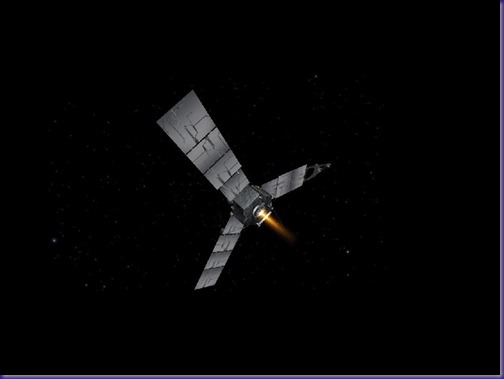
Juno firing rockets


Mission Elapsed Time:
495 Days (1.36 yrs.) 09 Hours 39 Minutes

Time of Earth Flyby Gravity Assist:
300 Days (.82 yrs.) 06 Hours 17 Minutes

Juno's Time of Arrival:
1300 Days ( 3.55 yrs.) 00 Hours 18 Minutes


Juno is currently headed back toward the inner solar system for a planned Earth flyby gravity assist maneuver on Oct. 9, 2013. The gravity assist will give the spacecraft the boost it needs to reach Jupiter, where it is slated to arrive in July 2016. 


Junos position12-12-12

Juno's Current Position 12/12/12

As of Dec. 10, Juno was approximately 216 million miles (347 million kilometers) from Earth, with a one-way radio signal travel time of approximately 19 minutes. The spacecraft has now traveled 561 million miles (903 million kilometers, or 6.03 AU) since launch. Juno is currently traveling at a velocity of 10 miles (16 kilometers) per second relative to the sun. Velocity relative to Earth is 23 miles (37 kilometers) per second.  The Juno spacecraft is in excellent health and is operating nominally. Four instruments -- JEDI, MWR, Waves, and MAG -- are turned on.

Now for a little past history about the first mission to Jupiter Galileo: 

At Kennedy Space Center, Oct. 18, 1989:   A roar shakes the ground as Space Shuttle Atlantis climbs into the sky. The Galileo spacecraft rides in the payload bay, ready to begin a long journey into the realm of the outer planets. Its mission is to study Jupiter and its moons in more detail than any previous spacecraft.
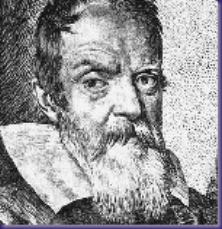
 

Galileo

Galileo

The spacecraft is named in honor of the first modern astronomer --- Galileo Galilei. He made the first observations of the heavens using a telescope in 1610.  What compels us to explore Jupiter? The giant colorful planet holds clues to help us understand how the Sun and planets formed more than 4.5 billion years ago. One of Jupiter's moons has active volcanoes and others have strange icy terrain. How does these strange worlds compare with Earth?


galileo spacecraft arrival at Jupiter

Galileo Spacecraft Arriving at Jupiter


Galileo arrived at Jupiter in December 1995.  As fascinating data poured in from the orbiting spacecraft and its atmospheric probe, we knew it was just the beginning.   Galileo changed the way we look at our solar system. The spacecraft was the first to fly past an asteroid and the first to discover a moon of an asteroid. It provided the only direct observations of a comet colliding with a planet.
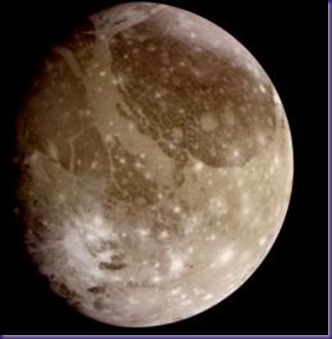
 

Galileo Ganymede

Galileo Ganymede

Galileo was the first to measure Jupiter's atmosphere with a descent probe and the first to conduct long-term observations of the Jovian system from orbit. It found evidence of subsurface saltwater on Europa, Ganymede and Callisto and revealed the intensity of volcanic activity on Io.


Galileo Callisto

Galileo Callisto

The history of Jupiter exploration began with the invention of the telescope in the early seventeenth century. The first telescopes were not very powerful, and the views were not very sharp. But over the next three hundred years, the telescope was continually improved, and became our primary tool for observing the stars and planets.


Galileo Io

                                      Galileo Io

Human explorers have taken dangerous journeys to the far corners of Earth and even to the Moon. But to explore the outer reaches of the solar system, we send spacecraft equipped with cameras and scientific instruments. In a way, we send extensions of ourselves on these missions.
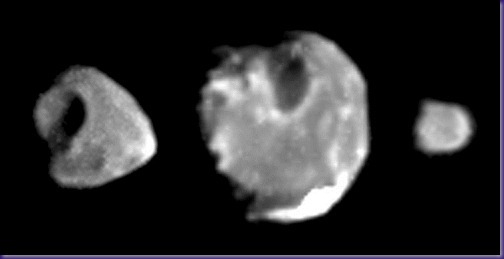
Galileo moons  Thebe, Amalthea and Metis

Galileo moons  Thebe, Amalthea and Metis

The cameras becomes our "eyes" to view the other planets up close. Special instruments "see" in infrared, ultraviolet, and other wavelengths of light --- revealing what is invisible to our eyes.  Today, we have very large and powerful telescopes. The Hubble Space Telescope, orbiting above Earth's atmosphere, can see far into space. Yet, the planets of our Solar System still hold many mysteries to investigate. NASA's first planetary missions were "fly-bys." The spacecraft simply zoomed by a planet taking pictures or gathering data, and then continued on --- out into deep space.


Great Red Spot Collage:


Jupiter collage


But orbiting a planet gives us a chance to learn a great deal more about it. The Viking orbiters at Mars and the Magellan orbiter at Venus studied planets in the inner solar system. Galileo was the first spacecraft to orbit Jupiter in the outer solar system.


Galileo eurropa surface features


Galileo plunged into Jupiter's crushing atmosphere on Sept. 21, 2003.  The spacecraft was purposely put on a collision course with Jupiter because the onboard propellant was nearly depleted and to eliminate any chance of an unwanted impact between the spacecraft and Jupiter's moon Europa, which Galileo discovered and is likely to have a subsurface ocean.  The Galileo spacecraft's 14-year odyssey came to an end on Sunday, Sept. 21, when the spacecraft passed into Jupiter's shadow then disintegrated in the planet's dense atmosphere at 11:57 a.m. (PDT). The Deep Space Network tracking station in Goldstone, Calif., received the last signal at 12:43:14 (PDT). The delay is due to the time it takes the signal to travel to Earth.

Galileo_End burning up in Jupiter's atmos.

Galileo is directed to crash into Jupiter and burns up in the atmosphere.

Wednesday, October 17, 2012

Juno Mission Update 10/17/12


Juno fires its main engine


Mission Elapsed Time:  439 Days (1.20 yrs.) 11 Hours 25 Minutes

Time of Arrival:  1355 Days ( 3.71 yrs.) 22 Hours 35 Minutes


Juno is approximately 282 million miles (452 million kilometers) from Earth, with a one-way radio signal travel time of approximately 25 minutes. The spacecraft has now traveled 512 million miles (824 million kilometers) since launch, which is nearly 27 percent of its total cruise distance to Jupiter. Juno is currently traveling at a velocity of 33,600 miles (54,000 kilometers) per hour relative to the sun. Velocity relative to Earth is 94,900 miles (152,600 kilometers) per hour.


Juno 10-17-12

Juno’s Current Position and Course

The Juno spacecraft is in excellent health and is operating nominally. Four instruments -- JEDI, MWR, Waves, and the magnetometer experiment -- are turned on. Juno’s mission operations team is currently focused on periodic maintenance activities for the science instruments, turning on each one for a few days at a time to monitor its health and performance.  Juno is currently headed back toward the inner solar system for a planned Earth flyby gravity assist maneuver on Oct. 9, 2013. The spacecraft completed a trajectory control maneuver (TCM-5) using its reaction control thrusters on Oct. 3, for the fifth time further refining its path toward Earth.  Juno was not designed to study the Jovian moons, but may take a few distant images.  More detailed info in the future on this subject.


Jupiter's trojan asteroids

New results from NASA's Wide-field Infrared Explorer, or WISE, reveal that the Jovian Trojans -- asteroids that lap the sun in the same orbit as Jupiter -- are uniformly dark with a hint of burgundy color, and have matte surfaces that reflect little sunlight.   The color could indicate heavy concentration of the element Iron.

Scientists using data from NASA's Wide-field Infrared Survey Explorer, or WISE, have uncovered new clues in the ongoing mystery of the Jovian Trojans -- asteroids that orbit the sun on the same path as Jupiter. Like racehorses, the asteroids travel in packs, with one group leading the way in front of the gas giant, and a second group trailing behind.  The observations are the first to get a detailed look at the Trojans' colors: both the leading and trailing packs are made up of predominantly dark, reddish rocks with a matte, non-reflecting surface. What's more, the data verify the previous suspicion that the leading pack of Trojans outnumbers the trailing bunch.
The new results offer clues in the puzzle of the asteroids' origins. Where did the Trojans come from? What are they made of? WISE has shown that the two packs of rocks are strikingly similar and do not harbor any "out-of-towners," or interlopers, from other parts of the solar system. The Trojans do not resemble the asteroids from the main belt between Mars and Jupiter, nor the Kuiper belt family of objects from the icier, outer regions near Pluto.
"Jupiter and Saturn are in calm, stable orbits today, but in their past, they rumbled around and disrupted any asteroids that were in orbit with these planets," said Tommy Grav, a WISE scientist from the Planetary Science Institute in Tucson, Ariz. "Later, Jupiter re-captured the Trojan asteroids, but we don't know where they came from. Our results suggest they may have been captured locally. If so, that's exciting because it means these asteroids could be made of primordial material from this particular part of the solar system, something we don't know much about." Grav is a member of the NEOWISE team, the asteroid-hunting portion of the WISE mission.

JUno german astronomer Max Wolf

Astronomer Max Wolf

The first Trojan was discovered on Feb. 22, 1906, by German astronomer Max Wolf, who found the celestial object leading ahead of Jupiter. Christened "Achilles" by the astronomer, the roughly 81-mile-wide (130-kilometer-wide) chunk of space rock was the first of many asteroids detected to be traveling in front of the gas giant. Later, asteroids were also found trailing behind Jupiter. The asteroids were collectively named Trojans after a legend, in which Greek soldiers hid inside in a giant horse statue to launch a surprise attack on the Trojan people of the city of Troy.


JUno-Wise spacecraft


NASA's Wide-field Infrared Survey Explorer, or WISE, spacecraft is situated on a work stand. At left on the spacecraft is the fixed panel solar array. In front, the square is the HGA Slotted Array (Ku-Band).

Friday, September 21, 2012

Juno Mission Update 9/21/12


Juno firing main rockets

Elapsed Mission Time:  413 Days (1.23 yrs.) 04 Hours 57 Minutes

Time of Arrival:  1387 Days (3.8 yrs.) 08 Hours 02 Minutes


As of Sept. 19, Juno was approximately 294 million miles (473 million kilometers) from Earth, with a one-way radio signal travel time of approximately 26.4 minutes. The spacecraft has now traveled 495 million miles (797 million kilometers) since launch. Juno is currently traveling at a velocity of 33,200 miles (53,400 kilometers) per hour relative to the sun. Velocity relative to Earth is 97,000 miles (156,100 kilometers) per hour. The spacecraft is in excellent health and is operating nominally. Three instruments -- MWR, Waves, and the magnetometer experiment -- are turned on and collecting data.


Juno fires its main engine

Juno Firing It’s Main Engine


Juno’s second deep space maneuver (or DSM) was performed on Sept. 14; the first maneuver was successfully completed on Aug. 30. Following these two large main engine burns, the spacecraft was put back into cruise configuration and is now headed back toward the inner solar system for a planned Earth flyby gravity assist maneuver which will occur on Oct. 9, 2013. The two deep space engine burns were back-to-back successes !


Juno 9-21

Juno's Current Course and Position

NASA could have spent fuel for thrusters or use power for reaction wheels w/ moving parts. But Juno being a "simple spinner" spacecraft has its advantages. Spinning makes the spacecraft stable, like a gyroscope. Simpler than using reaction wheels, and no moving parts to wear out.

Friday, August 31, 2012

Juno Mission Update 8/31/12


Juno artist concept


Mission Elapsed Time:
392 days (1.07 yrs.) 04 Hours 47 Minutes


Time of Arrival:
1463 Days (4.01 yrs.) 05 Hours 14 Minutes


As of Aug. 29, Juno was approximately 302 million miles (486 million kilometers) from Earth, with a one-way radio signal travel time of approximately 27.1 minutes. The spacecraft has now traveled 478 million miles (769 million kilometers) since launch, or approximately 25 percent of the 20.49 AU distance that the spacecraft covers between launch and arrival at Jupiter.


Juno Communications

Juno is currently traveling at a velocity of 34,000 miles (54,700 kilometers) per hour relative to the sun. Velocity relative to Earth is 99,200 miles (159,600 kilometers) per hour. The spacecraft is in excellent health and is operating nominally. All instruments except the Advanced Stellar Compass (part of the magnetometer experiment) are turned off, as planned, in preparation for the deep space maneuvers.


Juno position and course

View of Juno’s position on Aug. 30 from Eyes on the Solar System.

Jupiter-Bound Juno Changes its Orbit

Earlier today, navigators and mission controllers for NASA's Juno mission to Jupiter watched their computer screens as their spacecraft successfully performed its first deep-space maneuver. This first firing of Juno's main engine is one of two planned to refine the spacecraft's trajectory, setting the stage for a gravity assist from a flyby of Earth on Oct 9, 2013. Juno will arrive at Jupiter on July 4, 2016.
The deep-space maneuver began at 6:57 p.m. EDT (3:57 p.m. PDT) today, when the Leros-1b main engine was fired for 29 minutes 39 seconds. Based on telemetry, the Juno project team believes the burn was accurate, changing the spacecraft's velocity by about 770 mph (344 meters a second) while consuming about 829 pounds (376 kilograms) of fuel.

Juno firing rockets

Artist’s concept depicts NASA’s Juno spacecraft during a burn of its main engine.


"This first and successful main engine burn is the payoff for a lot of hard work and planning by the operations team," said Juno Project Manager Rick Nybakken of NASA's Jet Propulsion Laboratory in Pasadena, Calif. "We started detailed preparations for this maneuver earlier this year, and over the last five months we've been characterizing and configuring the spacecraft, primarily in the propulsion and thermal systems. Over the last two weeks, we have carried out planned events almost every day, including heating tanks, configuring subsystems, uplinking new sequences, turning off the instruments and increasing the spacecraft's spin rate. There is a lot that goes into a main engine .
The burn occurred when Juno was more than 300 million miles (483 million kilometers) away from Earth. A second deep space maneuver, of comparable duration and velocity change, is planned for Sept. 4. Together, they will place Juno on course for its Earth flyby, which will occur as the spacecraft is completing one elliptical orbit around the sun. The Earth flyby will boost Juno's velocity by 16,330 mph (about 7.3 kilometers per second), placing the spacecraft on its final flight path for Jupiter. The closest approach to Earth, on Oct. 9, 2013, will occur when Juno is at an altitude of about 310 miles (500 kilometers).

simulation of Junos deep space maneuver

Simulated view of Juno during its first deep space maneuver

One of Juno’s deep space maneuvers (or DSMs), took place on Aug. 30 and the next maneuver on Sept. 4. During these maneuvers the spacecraft will fire its main engine for 30 minutes. The maneuvers refine the spacecraft’s trajectory and set up the Earth flyby gravity assist maneuver in Oct. of next year. Nominal start time (spacecraft event time) for the burns is 22:30 UTC (3:30pm US Pacific time) on both dates; Earth received time for the signals from the spacecraft is 27 minutes later.

After the Earth flyby it will be another 1.4 billion miles and four years to go to get to Jupiter.  Scott Bolton, Juno's principal investigator from the Southwest Research Institute in San Antonio stated, "The team will be busy during that whole time, collecting science data on the way out to Jupiter and getting ready for our prime mission at Jupiter, which is focused on learning the history of how our solar system was formed. We need to go to Jupiter to learn this history because Jupiter is the largest of the planets, and it was formed by grabbing most of the material left over from the sun's formation."  Probably much of what was to go Mars was gobbled up by Jupiter- hence Mar's size. Earth and the other planets are really made from the leftovers of the leftovers, planetesimals and asteroids from the early Solar System. The asteroid belt would have been more heavily populated than now. So if we want to learn about the history of the elements that made Earth and life, we need to  understand what happened when was Jupiter formed .


asteroid belt early

The Early Asteroid Belt

Wednesday, August 8, 2012

Juno Mission Update 8/8/12


JUno spacecraft 2


Mission Elapsed Time:

369 (1.01 yrs.) Days 08 Hours 50 Minutes

Time of Arrival:

1426 ( 3.91 yrs.) Days 01 Hours 02 Minutes


JPL issued a news note  with that most dreaded of press release titles: "Mission Status Report," which some dread because it's usually a euphemism for "something bad has happened to one of our spacecraft." But this time it contains nothing but good news. It briefly notes that the Jupiter-bound Juno spacecraft has successfully completed some of the first of  the twelve trajectory correction maneuvers it'll perform between the launch last year and Jupiter arrival in 2016. Its next maneuver will take place in August of this year (this month). NASA's Juno spacecraft is outbound from the Sun, heading way beyond Mars' orbit before heading sunward again ending in a  Earth flyby in August 2013  that will send it on to a July 2016 Jupiter arrival.


Juno position 8-8-12

Juno’s Present Position and Course 8/8/12

Juno's science objectives are to:


1. Determine how much water is in Jupiter's atmosphere, to help identify which planet formation theory is correct .

2. Look deep into Jupiter's atmosphere to measure composition, temperature, cloud motions and other properties

3. Map Jupiter's magnetic and gravity fields, revealing the planet's deep structure

4. Explore and study Jupiter's magnetosphere near the planet's poles, especially the auroras, providing new insights about how the planet's enormous magnetic force field affects its atmosphere.


Juno south pole

A simulated view of Jupiter's South Pole illustrates Juno's unique perspective which will allow Juno's camera to image Jupiter's clouds from a vantage point never seen before.

Juno's investigations focus on four themes:

1. Origin – Jupiter's solid core and abundance of heavy metals in the atmosphere make it an ideal model to understand the origin of giant planets. Juno will measure global abundances of oxygen and nitrogen by mapping the gravitational field and using microwave observations of water and ammonia.

2. Interior – Juno will map Jupiter's gravitation and magnetic fields, revealing the interior structure, the origin of the magnetic field, the mass of its core, the nature of deep convection, and the abundance of water.


The Interior of Jupiter


3. Atmosphere – Jupiter has the most massive atmosphere of all the planets. By mapping variations in atmospheric composition, temperature, cloud opacity and dynamics to depths greater than 100 bars at all latitudes, Juno will determine the global structure and dynamics of Jupiter’s atmosphere below the cloud tops for the first time.

4. Magnetosphere–Jupiter’s powerful magnetospheric dynamics create the brightest aurora in our solar system. Juno will measure the distribution of the charged particles, their associated fields, and the concurrent UV emissions of the planet’s polar magnetosphere, greatly improving our understanding of this remarkable phenomena.


Juno Jupiter aurora

Auroras at Jupiter's North and South Poles

Jupiter’s Auroras

Wednesday, June 27, 2012

Juno 3 Mission Update 6/27/12


Mission Elapsed Time:  327 days (.90 yrs.) 10 hours 25 minutes

Time of Arrival:  1467 days (4.01 yrs.) 23 hours 37 minutes


JunoAboveClouds


As of June 20, Juno was approximately 287 million miles (462 million kilometers) from Earth, with a one-way radio signal travel time of approximately 25.7 minutes. The spacecraft has traveled 419 million miles (674 million kilometers) since launch, which represents approximately 22 percent of the total distance Juno will cover between launch and arrival at Jupiter. That distance is 20.49 astronomical units (1.9 billion miles, or 3.1 billion kilometers), or nearly five times greater than the separation between the orbits of Earth and Jupiter.


Juno on 6-27-12

Juno’s present Course and position as of this post

Juno is currently traveling at a velocity of 36,100 miles (58,100 kilometers) per hour relative to the sun. Velocity relative to Earth is 99,100 miles (159,400 kilometers) per hour. The spacecraft is in excellent health and is operating nominally. Four instruments are turned on: the Magnetometer experiment (FGM & ASC), JEDI, MWR and Waves:


Magnetometry 101
Most recent spacecraft significant events:

On June 20, flight controllers commanded the spacecraft to test opening and closing the external cover that protects its main engine, and to fill the propellant lines that supply the engine with liquid oxygen and hydrazine, in preparation for its upcoming deep space maneuvers, slated for Aug. 30 and Sept. 4.


Mission Timeline:

1. Launch - August 5, 2011
2. Deep Space Maneuvers - August/September 2012
3. Earth flyby gravity assist - October 2013
4. Jupiter arrival - July 2016
5. Spacecraft will orbit Jupiter for about one year (33 orbits)
6,  End of mission (deorbit into Jupiter) - October 2017

Juno will take an orbit that will give it an Earth gravity assist once it goes around the sun and heads back towards Jupiter.  This is what is called the "sling-shot" effect and will save on the spacecraft's use of fuel: